
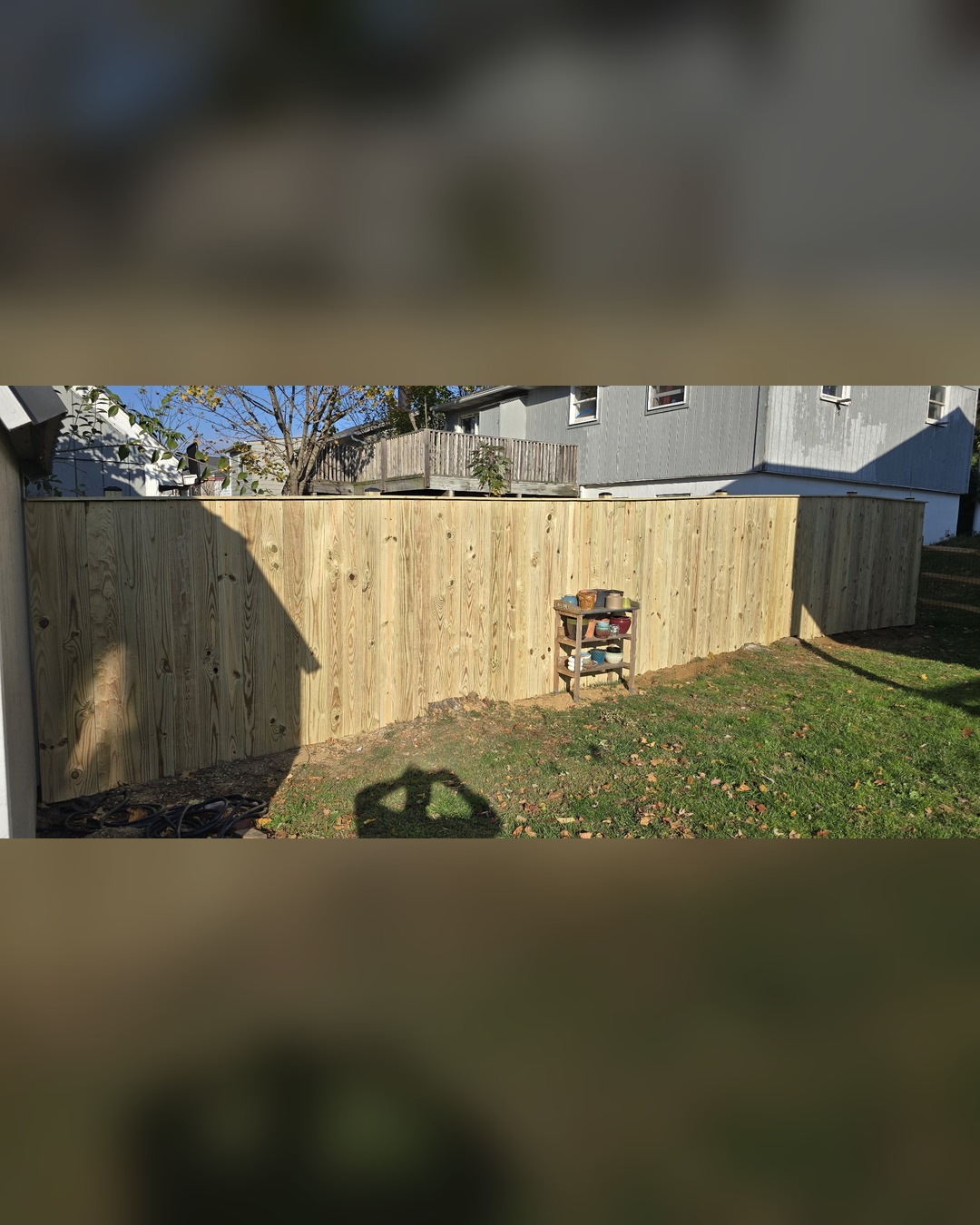
For our current winter construction update covering fences, decks, screen rooms, and screened porches, read how Darling Builders builds through the winter.
One of the questions I hear as summer ends is whether it is too late in the year to install a fence.
The short answer is no.
A fence can often be installed during fall and portions of the winter in Washington County and Frederick County, Maryland. Cooler weather by itself does not prevent a good installation.
The more important questions are:
- Is the ground frozen or saturated?
- Can the post holes be excavated properly?
- Can the concrete be placed and protected correctly?
- Are the materials suitable for the conditions?
- Can the yard be accessed without causing unreasonable damage?
- Is severe weather expected during the work?
I do not judge the calendar alone. I look at the actual property, soil, weather forecast, fence design, and materials before deciding whether conditions are suitable.
Fall can be a practical time to install a fence
Spring is a popular time to plan outdoor projects, but it is not automatically the best time for every fence.
A fall installation can make sense when a homeowner wants to:
- Secure the yard for children or pets
- Replace a failing or storm-damaged fence
- Correct a gate that no longer closes
- Prepare for a pool project
- Add privacy before leaves disappear from surrounding trees
- Complete the work before the next outdoor season
- Avoid spending another winter looking at a damaged fence
By early fall, homeowners also have a better understanding of how they used their property during the summer.
They may have discovered that a gate is too narrow for lawn equipment, the dog needs a more secure area, the patio needs privacy, or a slope requires a different layout than originally expected.
Those are useful design details regardless of the season.
Cold weather is not the same as frozen ground
A cool morning does not automatically stop fence installation.
Post holes can usually still be excavated when the soil is workable. The larger concern is ground that has frozen deeply enough to prevent proper excavation or ground that repeatedly freezes and thaws while the work is underway.
I do not want a post hole to be made shallower simply because the ground became difficult to dig.
For my typical fence installations, line-post depth is generally planned in the 24-to-30-inch range, subject to the fence, grade, soil, approved design, site conditions, and applicable requirements. Gate posts receive additional consideration because they carry movement and leverage that an ordinary line post does not.
If the conditions do not allow the required hole to be excavated and prepared correctly, the responsible choice is to wait for better conditions.
Concrete needs more attention in cold weather
Fence posts are commonly supported with concrete, and lower temperatures change how that concrete sets and gains strength.
Cold concrete develops strength more slowly, and newly placed concrete must be protected from freezing. QUIKRETE’s cold-weather guidance identifies freezing before strength develops and slower setting as the two main concerns when temperatures approach freezing. [Source]
That does not mean concrete can never be used during cooler weather. It means the product instructions, temperature forecast, ground conditions, mixing, placement, and required protection all matter.
Depending on the conditions, cold-weather work may require:
- Selecting an appropriate concrete product
- Keeping materials at suitable temperatures
- Avoiding frozen soil inside the hole
- Protecting newly placed concrete
- Allowing additional time before loading a post
- Delaying gate installation or adjustment until the support has developed sufficient strength
- Rescheduling when the forecast is unsuitable
I do not believe in setting posts under questionable conditions simply to say the project was completed on a particular day.
Posts should not be installed over frozen material
Frozen soil, snow, ice, and standing water should not be treated as a dependable base beneath a fence post.
When frozen soil thaws, it can settle or lose support. Water collecting around a post can also contribute to movement and deterioration over time.
Before setting a post, I look at:
- Whether the bottom of the hole is stable
- Whether loose or frozen material needs removal
- Groundwater entering the hole
- Soil collapsing from the sides
- Nearby drainage
- The slope around the post
- Whether water will collect at grade
- Whether the hole reached its intended depth
The goal is not simply to fill a hole with concrete. The post, soil, and concrete need to work together as a stable support.
Saturated fall soil can be as important as temperature
Some of the most difficult installation conditions occur after extended rain rather than during cold weather.
Wet soil can:
- Collapse into the post hole
- Make it difficult to maintain the intended dimensions
- Create muddy access conditions
- Allow equipment to damage the yard
- Collect water around the concrete
- Make it harder to keep posts aligned during installation
- Reveal drainage problems that could affect the finished fence
A light rain does not necessarily stop every phase of a fence project. Several days of heavy rain may create conditions where waiting is better for the installation and the property.
This decision is site-specific. A level yard with well-draining soil may remain workable while a low or steep property nearby is saturated.
Fall makes drainage problems easier to notice
Installing a fence without considering water movement can create future problems.
During an estimate, I look for:
- Downspouts discharging near the fence
- Low areas that hold water
- Erosion around existing posts
- Swales that carry runoff
- Water coming from a neighboring property
- Areas where mulch or soil has been piled against a fence
- Slopes that affect the bottom of the fence
- Locations where leaves and debris collect
If an existing post is leaning, I want to understand whether the cause is inadequate support, gate leverage, erosion, soft soil, or several of those conditions together.
Replacing the post without considering the reason it moved may allow the same problem to return.
Wood fencing can be installed during cooler weather
Pressure-treated wood fencing can often be constructed in fall or winter when the ground and concrete conditions are suitable.
Wood naturally changes as its moisture content and the weather change. Boards may shrink, swell, cup, or develop small checks over time.
That movement does not mean the fence was necessarily installed incorrectly. It does mean the layout and fastening should account for the fact that exterior wood is not dimensionally fixed.
During cold-weather wood-fence installation, I pay attention to:
- Board condition
- Picket spacing
- Rail layout
- Fastener placement
- Post alignment
- Ground clearance
- Grade changes
- Gate framing and bracing
Homeowners should also understand that staining or sealing may need to occur later. The wood, product instructions, weather, temperature, and moisture conditions determine when a finish can be applied successfully.
Installing the fence and applying a finish do not always need to happen at the same time.
Vinyl fencing requires careful handling in colder temperatures
Vinyl fencing can also be installed outside the summer months, but the material should be handled appropriately for the temperature and the manufacturer’s instructions.
Cold materials may respond differently to cutting and impact than they do on a warm day. Temperature changes also affect expansion and contraction.
Important details include:
- Following required post spacing
- Providing the intended rail engagement
- Allowing for product movement
- Avoiding unnecessary impact
- Supporting gate hardware properly
- Using required internal reinforcement
- Keeping components clean and undamaged during installation
A vinyl gate still needs dependable structural support. The visible vinyl sleeve alone should not be assumed to carry all of the hinge load.
If a manufacturer places temperature limitations on fabrication, installation, or a specific component, those requirements should be followed.
Aluminum fencing can be a good cool-weather project
Aluminum fence panels are not affected by moisture in the same way as unfinished wood, but the installation still depends on proper excavation, post setting, alignment, gates, and grade transitions.
With aluminum fencing, I consider:
- Panel spacing
- Post alignment
- Racking or stepping on slopes
- Gate-opening dimensions
- Hinge and latch adjustment
- Pool-barrier requirements, when applicable
- Concrete conditions
- Clearance beneath the fence
Cold weather does not correct an uneven layout. Careful measurement remains just as important in December as it is in May.
Gates deserve additional attention
The gate is usually the most heavily used part of a fence.
It swings, carries its weight from one side, catches wind, and transfers leverage into its hinge post. Seasonal soil movement can make an undersupported gate problem more noticeable.
For typical Darling Builders fence installations, I use 6×6 posts at gates, with the specific support depending on the gate size, weight, material, soil, grade, and site conditions.
During a fall or winter installation, I also consider:
- Whether the gate will clear the ground if frost or mud changes the surface
- How snow may affect the swing
- Whether a walkway or patio sheds water toward the opening
- The direction the gate should open
- The weight of each gate leaf
- Whether a double gate needs dependable center support
- When the posts can safely carry the gate
- Whether the latch will remain adjustable
A gate should not be hung on a newly set post before its support is ready to carry that load.
For more information, homeowners can read my guide to sagging fence-gate repairs.
Pool fences remain safety barriers in every season
A pool fence is not merely a property feature. It is part of a safety barrier.
If a pool gate no longer closes and latches reliably, colder weather is not a reason to ignore it. Access should be limited until the barrier can be evaluated and corrected.
A pool-fence project may involve requirements for:
- Fence height
- Openings
- Ground clearance
- Gate direction
- Self-closing hinges
- Self-latching hardware
- Latch location
- Spacing between components
- Protection around the entire pool area
Those requirements depend on the property and jurisdiction. A winter pool closure does not automatically eliminate the need to maintain the required barrier.
Less vegetation can make the fence line easier to evaluate
Once leaves fall and some landscaping becomes dormant, portions of a property may be easier to see and access.
That can help reveal:
- Old wire or abandoned fencing
- Stumps
- Vines wrapped around posts
- Drainage channels
- Uneven grade
- Hidden concrete
- Erosion
- Property markers
- Private landscape wiring or irrigation components
However, dormant landscaping is not disposable landscaping. Trees, shrubs, roots, lighting, drainage, and irrigation still need to be identified and protected.
Any clearing included in the project should be described in the estimate. Homeowners should not assume removal of every obstruction is automatically included.
Lawn disturbance can look different during fall and winter
Fence construction requires people and materials to travel through the property.
During dry conditions, that disturbance may be limited. During wet fall or winter weather, repeated foot traffic and equipment can leave ruts or muddy areas.
Before work begins, I consider:
- Access from the road or driveway
- Where materials can be placed
- Whether gates or narrow paths limit access
- Steep or soft portions of the yard
- Septic components
- Drainage systems
- Recently seeded areas
- Decorative landscaping
- Areas where restoration may need to wait for better growing weather
A fence may be completed successfully during winter while grass restoration needs to occur later. That expectation should be discussed before construction rather than treated as a surprise afterward.
Utility locating is still required in cold weather
The season does not change the need to locate underground utilities before excavation.
Miss Utility’s current Maryland guidance says the locate request should be submitted at least three full business days, but no more than 12 business days, before excavation or demolition is expected to begin. [Source]
When Darling Builders performs the excavation, I submit the Miss Utility request.
The homeowner must still identify private underground items that the public utility owners may not mark, including:
- Irrigation
- Invisible pet fencing
- Private electrical lines
- Landscape lighting
- Drainage piping
- Propane lines
- Well or septic components
- Privately installed communication lines
Leaves, snow, or dormant grass can make privately installed systems harder to recognize. Photos, plans, invoices, and information from previous property owners can be helpful.
Permits and HOA rules do not disappear after summer
Fence requirements depend on the property and jurisdiction.
Frederick County currently states that a county fence permit is generally not required for property outside Frederick City and incorporated towns, but homeowners should still confirm height and setback requirements with Zoning Administration. Municipalities can have separate rules. [Source]
Washington County provides online permitting, zoning, codes, forms, and inspection information through its Division of Permits and Inspections. The requirements for a specific property should be confirmed before work begins. [Source]
For Darling Builders projects:
- I explain when a permit is required.
- When a permit is required for our contracted work, I handle pulling it unless the agreement states otherwise.
- The customer supplies the HOA documents and obtains HOA approval.
- I help complete construction-related portions of an HOA submission.
- The customer confirms the property line unless surveying is separately included.
- Darling Builders contacts Miss Utility when our work requires excavation.
A county rule, municipal rule, HOA restriction, easement, and property line are different issues. Approval from one does not automatically resolve the others.
Homeowners can review my Maryland fence and deck permit guide for a more complete explanation.
Will a fall or winter project be completed faster?
Possibly, but I would not promise it based only on the season.
Scheduling depends on:
- Current project backlog
- Material availability
- Permit or HOA approval
- Utility locating
- Weather
- Ground conditions
- Product lead times
- Holidays
- The size and complexity of the project
Some cooler-weather periods provide good working conditions. Others bring repeated rain, frozen ground, or rapid temperature changes.
A realistic schedule should include enough flexibility to avoid forcing excavation or concrete work during unsuitable conditions.
Is fall or winter installation less expensive?
Not automatically.
A fence should be priced according to its footage, materials, gates, removal, clearing, grade, access, post requirements, hardware, and other project-specific work.
I would not recommend selecting a construction season solely because someone promises a seasonal discount.
A lower price does not help if the fence is missing proper gate support, adequate post installation, removal, dependable hardware, or another part of the expected scope.
The best comparison is still the written scope. My guide to comparing deck and fence estimates explains the details homeowners should review.
When does waiting make sense?
Waiting for better conditions may be appropriate when:
- The ground is deeply frozen
- Soil is saturated and collapsing into the holes
- Standing water cannot be managed
- Concrete cannot be placed and protected according to requirements
- Snow or ice prevents safe access
- The property line is uncertain
- HOA approval has not been obtained
- Required materials are unavailable
- The homeowner expects lawn restoration that cannot be completed during winter
- The weather would create an unreasonable risk of property damage
- The design has not been finalized
A weather delay is frustrating, but it is usually less expensive than correcting posts that moved because the installation was rushed.
Reasons not to wait until spring
There are also good reasons to begin planning now:
- A pet or child needs a secure yard
- An existing fence is unstable
- A pool barrier is not functioning properly
- The homeowner wants the yard ready before spring
- HOA and material selections may take time
- The fence layout needs careful planning
- A neighboring project will affect future access
- The homeowner wants privacy after leaves fall
- A failing gate or post is likely to worsen
Planning can continue even during weather that temporarily prevents installation.
Measurements, material selections, HOA documents, property information, estimates, and design decisions can all be addressed before the first post hole is excavated.
Want your yard ready before spring? Request an on-site fence estimate, and I’ll evaluate the layout, grade, gates, access, and ground conditions before recommending a practical installation plan.
What homeowners can do before the estimate
The following information helps me understand the project:
- Approximate fence footage
- Desired material and height
- Number and width of gates
- The purpose of the fence
- Whether it will serve as a pool barrier
- A copy of the property plat, if available
- HOA requirements
- Known easements
- Photos of the proposed fence line
- Areas that hold water
- Known private underground systems
- Existing fence-removal needs
- Access limitations
- The desired completion timeframe
If the fence is intended to contain a dog, I also want to know the dog’s size, behavior, and whether digging, jumping, or squeezing through openings is a concern.
My bottom line
You do not automatically have to wait until spring to install a fence in Maryland.
Fall can provide excellent working conditions, and some winter projects can also be completed successfully. The decision should be based on the soil, temperature, concrete requirements, forecast, property access, and fence design—not simply the month on the calendar.
I will move forward when the fence can be installed properly. If frozen ground, saturated soil, or another condition would compromise the work, I will explain the concern and adjust the schedule.
Darling Builders provides wood, vinyl, aluminum, pool-code, and gate installation and repair estimates throughout Washington County and Frederick County, Maryland.
Common questions
Frequently asked questions
Can a fence be installed during winter in Maryland?
Yes, a fence can often be installed during portions of the winter when the ground is workable and the posts and concrete can be installed correctly. Frozen soil, saturated ground, snow, ice, and temperature forecasts may require the work to be delayed.
How cold is too cold to set fence posts?
There is no single temperature that answers every situation. The concrete product, ground temperature, forecast, required protection, soil conditions, and manufacturer’s instructions all matter. Work should be postponed when the post support cannot be completed properly.
Will fence-post concrete cure in cold weather?
Concrete can develop strength in cool weather, but it sets more slowly and must be protected from freezing. Product instructions and appropriate cold-weather procedures should be followed.
Can frost cause fence posts to move?
Freeze-and-thaw cycles can contribute to movement when drainage, soil, post depth, or support is inadequate. Proper excavation, support, drainage, and installation details help reduce that risk.
Does wood fencing shrink after a winter installation?
Exterior wood can shrink or swell as its moisture content changes in any season. The fence should be constructed with the expected movement, fastening, spacing, and gate operation in mind.
Is fence installation less expensive during fall or winter?
Not necessarily. Pricing should reflect the materials, footage, gates, removal, clearing, access, grade, and installation requirements. Homeowners should compare the written scope rather than assume a particular season guarantees a lower price.
Do fence permits and HOA rules still apply during winter?
Yes. Seasonal timing does not remove applicable zoning, municipal, permit, HOA, easement, or property-line requirements.
Is Miss Utility required for a winter fence installation?
Yes. Excavation still requires the appropriate utility-locate process regardless of the season. Private underground systems must also be identified because they may not be included in public utility markings.
Plan your project
Let’s look at your property.
Darling Builders provides free on-site estimates throughout Washington and Frederick Counties, Maryland. We’ll discuss your goals, site conditions, materials, and the work your project requires.