
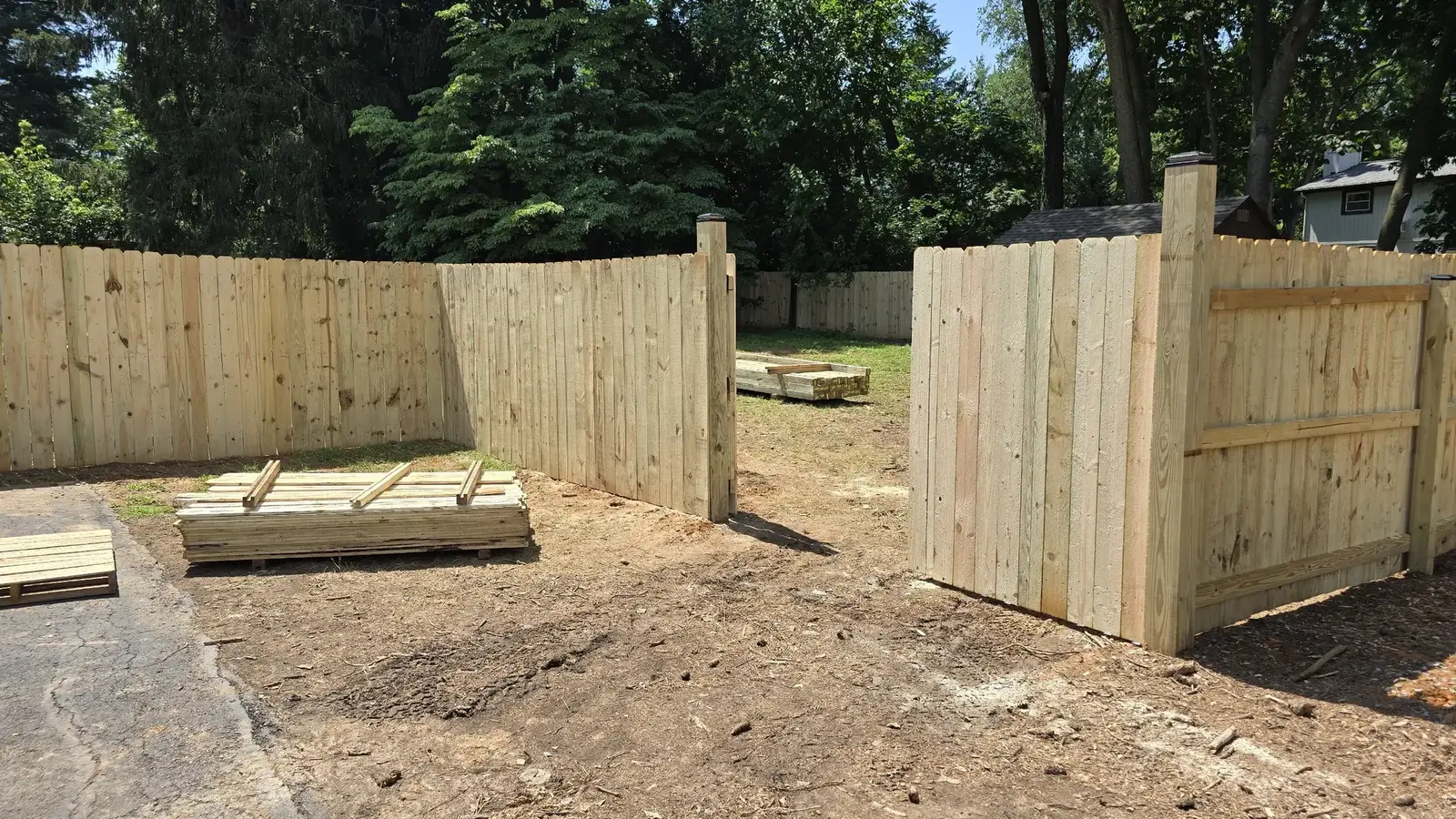
A leaning post, broken rail, loose vinyl panel, or gate that no longer closes does not automatically mean the entire fence needs to be replaced.
Sometimes the damage is isolated and a targeted repair makes sense.
Other times, the visible problem is only the first sign that several posts, rails, or sections are reaching the end of their useful life. Repairing one section may leave the homeowner paying for another repair a few months later.
When I evaluate a fence, I want to determine what failed, why it failed, and how much of the surrounding fence remains dependable.
That is how I decide whether a repair, partial replacement, or complete replacement is the most practical recommendation.
Start by walking the entire fence line
The section that first catches the homeowner’s attention is not always the only problem.
Before recommending a repair, I walk the fence line and look for:
- Leaning posts
- Movement at ground level
- Rotten or split wood
- Loose rails
- Missing pickets
- Cracked vinyl components
- Bent aluminum sections
- Damaged chain-link fabric
- Corroded hardware
- Gates that drag or will not latch
- Soil erosion
- Tree or limb damage
- Areas holding water
- Sections pulling away from one another
I also look at whether the damage follows a pattern.
One loose section near a fallen limb may be isolated storm damage. Several leaning posts along the same side of the property may point to age, soft soil, drainage, shallow installation, or inadequate support.
The repair should address the pattern—not only the worst-looking board.
The posts usually determine whether a repair is worthwhile
Fence boards and panels are the most visible parts of a fence, but the posts support the entire system.
A fence with sound posts can often accept new rails, panels, pickets, or hardware. A fence with several failing posts may require much more extensive work.
I check whether each post is:
- Plumb
- Solid at ground level
- Rotting near the soil
- Split around fasteners
- Moving inside its footing
- Surrounded by cracked or loose concrete
- Being pushed by roots
- Affected by erosion
- Sized appropriately for its location
- Strong enough for an attached gate
A wood post may look acceptable above ground while being deteriorated where it enters the soil.
If the post moves when the fence section is placed under normal pressure, tightening the rails will not correct the real problem.
One failed post can sometimes be replaced
An isolated post replacement may make sense when:
- The neighboring posts remain solid
- The rails and pickets are reusable
- The fence is otherwise in good condition
- The original layout still works
- Replacement material is available
- The repaired section can be properly aligned
- The cause of the failure can be corrected
Post replacement may involve removing the attached sections, dealing with the existing footing, installing the new post, and reinstalling or rebuilding the surrounding fence.
That can be practical for one or two posts. It becomes less attractive when posts are failing throughout the property.
The Darling Builders repair service includes post replacement, section reinstallation, structural reinforcement, gate alignment, and selective replacement where the remaining structure is sound. [Source]
Several failing posts can change the recommendation
If five posts are visibly leaning, there may be additional posts beginning to deteriorate.
In that situation, I consider:
- The age of the fence
- How many posts are failing
- Whether the remaining posts were installed the same way
- The condition of the rails and panels
- Material availability
- The cost of repeatedly taking sections apart
- Whether the homeowner still wants the same style and layout
- Whether the gates need redesign
- Whether a complete replacement would provide a better long-term result
Replacing posts one at a time can become expensive because each repair requires mobilization, excavation, disassembly, alignment, and cleanup.
I do not recommend full replacement simply because a fence is older. I also do not want to present repeated isolated repairs as the economical choice when the entire support system is deteriorating.
Wood fence repairs depend on the posts, rails, and pickets
Wood fencing can often be repaired in sections because individual components can be replaced.
Common wood-fence repairs include:
- Replacing posts
- Replacing rails
- Reinstalling loose pickets
- Replacing broken pickets
- Rebuilding a damaged section
- Realigning a leaning run
- Repairing or rebuilding a gate
- Replacing corroded hardware
The condition of the lumber matters.
A new rail cannot dependably connect to a post that is soft or badly split. New pickets may not last if the rails behind them are already deteriorated. A repaired section may also look noticeably different when new pressure-treated lumber is installed beside older, weathered boards.
That appearance difference does not always justify replacing the fence, but homeowners should know what to expect.
Vinyl fence repairs depend on the specific system
Vinyl fencing is assembled from posts, rails, panels, pickets, caps, and internal reinforcement.
Damage may involve:
- A cracked post
- A broken rail
- A panel that came apart
- Loose pickets
- Missing caps
- A leaning post beneath a vinyl sleeve
- Failed gate reinforcement
- Hinges pulling through the material
- Parts damaged by impact or cold-weather brittleness
A vinyl repair works best when compatible replacement parts are available.
Components that look similar are not necessarily interchangeable. Rail dimensions, routed post openings, panel construction, colors, textures, and internal reinforcement can vary by manufacturer and product line.
If the original product cannot be identified or obtained, a repaired section may require modification or may not match the rest of the fence.
Chain-link fencing can often be repaired in sections
Chain-link systems contain several separate components:
- Terminal and line posts
- Top rail
- Fence fabric
- Tension wire
- Tension bars and bands
- Gates
- Hinges and latches
A bent top rail or damaged area of fabric does not always require replacing the full fence.
I still inspect the surrounding posts and connections. New fabric will not remain properly tensioned if the terminal post is loose or leaning.
A repair may be reasonable when the posts are solid and the damage is limited to an identifiable section. Replacement may be more practical when the entire run is heavily corroded, poorly aligned, or supported by failing posts.
Aluminum fence repairs require compatible components
Residential aluminum fencing commonly arrives as manufactured panels, posts, gates, and hardware.
A damaged panel may be replaceable if:
- The product can be identified
- The manufacturer still offers the style
- The dimensions match
- The color and finish remain available
- The surrounding posts are sound
If the original line has been discontinued, matching the height, rail positions, picket spacing, finish, and decorative details may be difficult.
Before promising an exact repair, I want to confirm what can actually be sourced.
Gates place extra stress on their posts
A gate is usually the hardest-working part of the fence.
It swings, carries its own weight, gets pulled and pushed, and may catch the wind. A wide privacy gate creates considerably more leverage than a stationary fence section.
When a gate sags or stops latching, I inspect:
- The hinge post
- The latch post
- Gate framing
- Hinges
- Latch hardware
- Fasteners
- Gate width
- Ground clearance
- Swing direction
- Wind exposure
- Drainage around the posts
Moving the latch may make the gate close temporarily, but it does not correct a leaning post or racked gate frame.
A gate repair can make sense when the posts remain solid and the frame or hardware can be restored. If the hinge post is loose or deteriorated, the post may need to be replaced before the gate can be properly rehung.
Drainage and soil movement should not be ignored
Fence problems often begin below the visible components.
I look for:
- Water collecting around posts
- Downspouts discharging along the fence
- Soil washing away
- Mulch piled against wood
- Soft or recently disturbed soil
- Roots pushing posts
- A steep grade
- Frost-related movement
- Vehicles or equipment striking the ground nearby
Resetting a post without addressing active erosion may allow the problem to return.
Likewise, installing additional fasteners between leaning sections does not correct movement at ground level.
The goal is to identify why the post moved and whether that condition can be improved as part of the repair.
Storm and impact damage may be a good repair candidate
Sudden damage from wind, falling limbs, vehicles, lawn equipment, or another impact is different from general deterioration.
Repair may be practical when:
- The damage has a clear cause
- The surrounding fence remains sound
- A limited number of components are affected
- Matching material is available
- The posts outside the affected area remain stable
- The original fence was otherwise performing properly
Photographs taken soon after the damage can help document what happened. Homeowners considering an insurance claim should contact their insurer about documentation and coverage before disposing of damaged materials.
Darling Builders can prepare a repair proposal, but I do not determine insurance coverage or promise that an insurer will approve a particular scope.
Partial replacement can sometimes be the best middle ground
The choice is not always between replacing one board and replacing the entire fence.
A practical scope might involve replacing:
- One side of a yard
- A damaged corner
- Several consecutive posts and sections
- A gate opening
- The front-facing portion of the fence
- A storm-damaged run
- An older section connected to a newer fence
Partial replacement can preserve useful portions of the existing fence while correcting the area that no longer performs properly.
The transition between old and new work should be planned. Post spacing, height, material, color, rail positions, and grade treatment need to meet cleanly.
Pool-barrier fences require additional care
A fence surrounding a swimming pool is a safety barrier.
A loose section, failed latch, excessive opening, or gate that no longer closes by itself should not be treated as an ordinary cosmetic concern.
Frederick County’s current pool-barrier guidance includes requirements for barrier openings and pedestrian gates. It states that pedestrian gates must open away from the pool and be self-closing and self-latching. [Source]
Washington County’s published pool materials also identify a 48-inch barrier requirement for applicable residential pools. [Source]
The exact requirements depend on the pool, fence, property, and jurisdiction.
If an existing pool gate does not close and latch dependably, I recommend limiting access and having it corrected promptly.
When does fence repair make sense?
Repair may be the practical choice when:
- Damage is isolated
- Most posts remain solid
- Rails and panels remain usable
- Compatible materials are available
- The original fence still meets the homeowner’s needs
- The repair can restore dependable alignment and support
- The repair cost is reasonable compared with replacement
- A clean transition can be achieved
I believe in repairing what can be repaired when the surrounding structure is worth preserving.
A targeted repair can extend the fence’s service life without replacing hundreds of feet unnecessarily.
When does full replacement make more sense?
Replacement may be the better choice when:
- Posts are failing throughout the fence
- The fence leans in several locations
- Rails and panels are also deteriorated
- Compatible replacement parts are unavailable
- Several temporary repairs have already been attempted
- The homeowner wants a different height, material, or layout
- Gate openings need to be redesigned
- The fence no longer serves its intended purpose
- Repairing isolated sections would leave widespread underlying problems
A complete replacement also provides an opportunity to reconsider privacy, pets, pool requirements, equipment access, double gates, maintenance, and the relationship between the fence and the property.
Do fence repairs require a permit?
Permit and zoning requirements depend on the jurisdiction and scope.
Frederick County states that a fence permit is generally not required for properties outside incorporated towns and Frederick City, but homeowners should confirm height and setback requirements with Zoning Administration. Incorporated municipalities can have separate rules. [Source]
Washington County’s published permit guidance identifies fences not over seven feet high among residential projects that do not require a building permit. Zoning, easements, pool-barrier rules, HOA restrictions, or municipal requirements may still apply. [Source]
For Darling Builders projects:
- I explain the permit requirements I identify.
- I handle permits required for our contracted work unless the agreement states otherwise.
- The homeowner provides HOA documents and obtains HOA approval.
- I help complete construction-related HOA information.
- Darling Builders contacts Maryland 811 when our work requires excavation.
- The homeowner identifies private underground systems.
- The homeowner confirms the property line unless surveying is separately included.
Repairing an existing fence does not prove where the property line is. If the boundary is uncertain, a licensed surveyor may be necessary before posts are replaced.
Why late fall is a useful time to inspect the fence
By November, leaves and summer growth often begin clearing away from the fence line.
That can make it easier to notice:
- Leaning posts
- Broken rails
- Rot near the ground
- Storm damage
- Loose gates
- Animal openings
- Erosion
- Branches resting on the fence
- Vegetation growing through panels
- Sections likely to worsen under winter wind or snow
Homeowners should not assume that every repair must wait for spring. Weather, soil, materials, access, and the exact work determine whether a project can proceed.
Early evaluation still helps, even when construction is scheduled later. It provides time to decide whether the correct scope is a repair, partial replacement, or new fence.
What to send when requesting a fence-repair estimate
Helpful information includes:
- A wide photograph of the damaged section
- Photographs of both sides of the fence
- Close-ups of the posts at ground level
- Pictures of the rails and connections
- Gate photographs
- A short video showing movement
- Approximate fence height
- Approximate damaged length
- Fence material
- The fence’s approximate age, if known
- Whether the problem changes after rain
- Whether the fence surrounds a pool
- Whether pets depend on the enclosure
- Known private utilities or drainage systems
- HOA documents or original product information
Photographs help me understand the likely scope, but an on-site inspection is normally needed before deciding whether the remaining structure is worth preserving.
My bottom line
A broken board does not automatically require a new fence, and a leaning fence is not always fixed by adding another screw.
The decision depends heavily on the posts, surrounding sections, material availability, cause of the damage, and what the homeowner needs the fence to do.
I would rather recommend a targeted repair when the remaining fence is sound. When deterioration is widespread, I also want to be straightforward about whether replacement will provide a better result than a series of temporary fixes.
Darling Builders provides fence, gate, and outdoor-repair estimates throughout Washington County and Frederick County, Maryland.
Unsure whether your fence needs one repaired section or a complete replacement? Send photographs through the estimate form, and I’ll evaluate the posts, panels, rails, gates, grade, and surrounding condition.
Common questions
Frequently asked questions
Can one leaning fence post be replaced?
Often, yes. If the neighboring posts, rails, and panels remain sound, an isolated post may be replaced and the surrounding sections reinstalled. The existing footing, soil, drainage, and material condition still need to be evaluated.
Does a leaning fence mean all the posts are failing?
Not necessarily. One post may have been damaged or poorly supported. Several leaning posts installed at the same time may indicate a broader problem with age, soil, drainage, depth, or installation.
Can part of a fence be replaced without replacing all of it?
Yes. A side, corner, gate opening, or group of damaged sections may be replaced when a clean structural and visual transition can be made to the remaining fence.
Can you match an older vinyl fence?
Sometimes. The manufacturer, product line, dimensions, color, finish, and routed openings need to be identified. Similar-looking components are not always interchangeable, and discontinued products may be difficult to match.
Is it worth repairing an old wood fence?
It depends on the posts, rails, pickets, amount of deterioration, and expected service life after the repair. One damaged section may be worth repairing, while widespread post and rail failure may make replacement more practical.
Should a fence gate be repaired or replaced?
A gate may be repaired when its posts remain solid and its frame or hardware can be restored. A twisted frame, loose hinge post, repeated hardware failure, or excessively heavy gate may justify rebuilding or replacing it.
Does fence repair require a Maryland 811 ticket?
When repair work requires excavation, Darling Builders submits the Maryland 811 request for our work. The homeowner must identify private systems that utility owners may not mark.
Can a damaged pool fence wait until spring?
A pool barrier with an opening, loose section, or gate that no longer closes and latches reliably should be addressed promptly. Limit access to the pool area until the barrier is dependable.
Plan your project
Let’s look at your property.
Darling Builders provides free on-site estimates throughout Washington and Frederick Counties, Maryland. We’ll discuss your goals, site conditions, materials, and the work your project requires.