
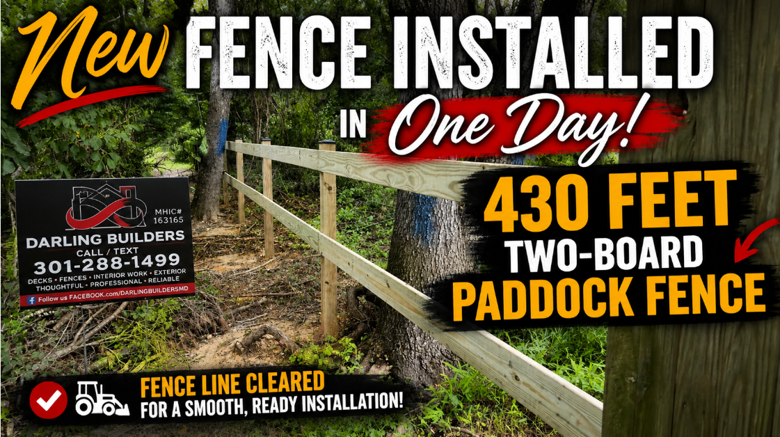
Paddock fencing can define a large property without making it feel closed in.
The horizontal boards fit naturally around fields, wooded lots, long driveways, and rural homes. The open design also preserves more of the view than a privacy fence.
But choosing a paddock fence involves more than deciding whether two boards or three boards look better.
Before I recommend a layout, I want to know what the fence needs to accomplish. Is it mainly a visible property boundary? Does it need to help contain a dog? Will equipment need to pass through it? Does the route cross a slope? Are there livestock considerations? Is the homeowner trying to match an existing fence?
Those answers determine the number of boards, whether wire should be added, where gates belong, and how the complete fence should be laid out.
Start with the job the fence needs to do
A rail-only paddock fence creates a clear visual boundary, but the openings between the rails remain large.
That may be perfectly appropriate when the goal is to define the edge of a property, complement a rural or wooded setting, separate parts of a large yard, mark the route along a driveway, preserve an open view, or match an existing farm-style fence.
It should not automatically be treated as a universal containment system.
Small animals may pass beneath or between the boards. A determined dog may dig under it. Different livestock have different containment needs. A pool barrier has its own requirements involving openings, height, gates, latches, and climbability.
I begin with the intended use so the homeowner does not choose a good-looking fence that cannot perform the job they expected.
What is the difference between two-board and three-board fencing?
The basic difference is straightforward: a two-board fence has two horizontal rails, while a three-board fence has three.
The practical difference involves appearance, spacing, material, visibility, and the intended use of the property.
When a two-board fence may make sense
A two-board layout has a lighter, more open appearance.
It can work well when the homeowner wants a visible boundary without putting as much visual weight around a large property. It also uses fewer horizontal boards than a comparable three-board layout.
I commonly consider a two-board design when the fence is primarily a visual boundary, preserving the view is important, the property has long runs, the homeowner prefers a simple open appearance, compatible wire will provide any additional containment needed, or the design needs to match an existing two-board fence.
The exact board spacing and fence height still need to be established in the proposal. Two-board fence alone does not completely describe the system.
When a three-board fence may make sense
A three-board layout has a fuller appearance and places another horizontal rail within the fence.
It may be the better fit when the homeowner prefers a more substantial farm-style appearance, the fence needs to match an existing three-board section, the selected wire and rail layout work better with three boards, the property’s proportions make a taller-looking fence more appropriate, or additional visible definition is wanted around the yard or field.
Adding another board does not automatically make the fence suitable for every animal. The spaces between and below the rails still need to be considered.
When should wire be added?
Wire is worth considering whenever a rail-only fence leaves openings that conflict with the property’s intended use.
That may include yards used by dogs, areas where smaller animals could pass through the rails, or locations where the owner wants a more complete physical barrier while keeping the paddock-fence appearance.
The wire should be selected as part of the fence system—not added as an afterthought.
Important details include wire type and opening size, finished height, bottom clearance, which side of the fence receives the wire, attachment method, support at corners and ends, how the wire follows the grade, gaps around gates, compatibility with the posts and rails, corrosion resistance, and future vegetation and maintenance.
A small opening on one part of the fence will not help if a large gap remains beneath a gate or where the ground drops away.
The intended animal matters too. Size, behavior, digging, climbing, jumping, and pressure against the fence all affect whether a particular layout is appropriate. Specialized livestock or electric-fence needs may require additional planning beyond a standard residential paddock system.
Wire does not correct a poorly planned fence
Wire can improve containment, but it cannot correct every layout problem.
If the post line wanders, the bottom gap changes repeatedly, corners lack suitable support, or gates do not match the surrounding fence, installing wire will not make those issues disappear.
Long fence runs magnify small inconsistencies. A change that seems minor at the first post may become much more noticeable several hundred feet later.
Before installation, I review property boundaries, sight lines, changes in grade, corners and curves, gate locations, road and driveway visibility, trees, roots, brush, drainage, equipment and material access, and transitions into existing fencing.
The complete route needs to be planned as one system.
Posts, corners, and ends carry the fence
The rails and wire are the parts homeowners notice first, but the posts carry the system.
Corners, ends, gates, and changes in direction deserve particular attention because they receive different forces than an ordinary section along a straight run.
I look at post size and spacing, hole depth and site conditions, concrete support, corner and end assemblies, rail joints, wire tension, drainage around posts, ground movement, and connections at existing fences or structures.
A long, straight fence depends on a dependable starting point, a consistent post line, and properly planned changes in direction. If wire will be tensioned, that needs to be considered before the posts and rails are installed.
Gates should be planned before the fence is laid out
A gate is not simply an opening left at the end of the project.
Its width, purpose, swing direction, grade, posts, hinges, latch, and surrounding fence all affect how well it works.
For a paddock-fence project, I ask whether the opening is intended for regular foot traffic, lawn equipment, trailers, larger maintenance equipment, vehicles, access to another field or part of the property, or emergency and secondary access.
A gate that is wide enough for today’s mower may not be wide enough for another piece of equipment the homeowner already uses.
The ground also needs to be checked through the gate’s complete swing. A gate may clear the ground when it is closed but strike a rising slope as soon as it opens.
Gate posts carry repeated weight and leverage, so their support should be planned differently from an ordinary section of stationary fence.
Grade changes affect boards, wire, and bottom gaps
Paddock fencing often crosses larger properties where the ground is not perfectly level.
The fence may need to follow gradual slopes, transition between different elevations, or work around wooded and uneven areas.
I pay attention to whether the boards can follow the grade cleanly, how changes will appear from a distance, bottom clearance beneath the wire, low areas where runoff collects, high spots that reduce gate clearance, erosion around posts, sudden grade changes at corners, and areas where vegetation may hide a gap.
The best approach depends on the property and the selected materials. The important part is to decide how the fence will respond to the grade before installation begins.
Consider maintenance along the entire route
Wood posts and rails will weather. Wire and fasteners should also be inspected over time.
On a long fence, different sections may experience different conditions. One area may receive full sun while another remains shaded and damp. A section near the driveway may be exposed to vehicles or snow removal, while another runs through vegetation.
Homeowners should periodically check for loose, split, or deteriorated boards; leaning or damaged posts; loose wire; corroded fasteners; vegetation growing into the fence; soil erosion; impact damage; gate movement; and changing gaps near the ground.
Catching an isolated problem early may allow a practical repair before it affects a longer section.
Confirm the property line and access
Before construction, the homeowner should be comfortable that the proposed route is on the correct property.
An existing fence, mowing line, tree line, or neighbor’s description should not automatically be treated as a surveyed boundary.
HOA requirements, easements, road visibility, setbacks, and local rules may also affect the layout.
When Darling Builders performs excavation, we contact Miss Utility for the public utility locate. Homeowners still need to identify private systems that may not be marked, such as invisible pet fencing, irrigation, private electrical lines, landscape lighting, drainage, well and septic components, propane lines, and privately installed communication lines.
These details matter even on a large property where the proposed fence seems far from the house.
Fall and winter can be useful planning seasons
A paddock fence does not automatically need to wait until spring.
Darling Builders installs fencing during the colder months when the weather, ground, access, products, and site conditions allow. Winter also gives homeowners an opportunity to evaluate the route when some vegetation has died back.
The schedule still depends on the individual property. Deep frost, snow, ice, saturated soil, unsafe access, or product limitations can affect the work.
The goal is not to force an installation into unsuitable conditions. It is to evaluate the actual site instead of assuming every outdoor project must stop for the season.
What to send with an estimate request
The following information helps me understand a paddock-fence project: the property address, rough measurements or a marked-up plat, photographs of the proposed route, the preferred two-board or three-board appearance, whether wire is being considered, the intended purpose of the fence, the type and number of gates, required equipment access, areas with slopes, woods, brush, or drainage, existing fencing that must remain or connect to the new work, HOA documents if applicable, and known private underground systems.
I still need to evaluate the property, but this information helps identify the important questions before the visit.
My bottom line
Two-board and three-board paddock fences can both create an attractive boundary for a Maryland property.
The right choice depends on more than the number of rails. I look at the intended use, view, wire, animals, grade, gates, corners, access, and complete fence route.
If a rail-only fence will do the job, there is no reason to add wire simply because it is available. If containment matters, the wire, bottom gaps, gate openings, and terrain need to be planned together.
Darling Builders installs two-board and three-board paddock-style fencing throughout Washington and Frederick Counties, Maryland.
Common questions
Frequently asked questions
Is two-board or three-board paddock fencing better?
Neither is automatically better. Two-board fencing has a more open appearance, while three-board fencing creates a fuller visual boundary. Intended use, wire, height, existing fencing, and personal preference should guide the decision.
Does a paddock fence need wire?
Not always. A rail-only fence may be suitable as a visible boundary. Wire may be appropriate when the openings between the boards do not meet the property’s containment goal.
Can paddock fencing contain dogs?
It depends on the dog, wire, bottom clearance, gates, terrain, and complete layout. A rail-only fence generally leaves openings that many dogs can pass through.
Can paddock fencing be used for livestock?
Possibly, but the animal species, size, behavior, management plan, wire, gates, and terrain must be considered. A standard rail-only layout should not be assumed to contain every type of livestock.
Can a paddock fence follow a slope?
Often, yes. The route and grade should be evaluated so the boards, wire, posts, and bottom clearances remain practical and visually consistent.
What kind of gates can be installed?
Pedestrian, equipment, driveway, and double-gate arrangements may be considered. The width, posts, support, hardware, swing, grade, and intended access should be defined in the proposal.
Can paddock fencing be installed through a wooded area?
Often, after the route, roots, vegetation, clearing limits, access, grade, and property boundary are evaluated. Any clearing should be included clearly in the written scope.
Does Darling Builders install paddock fences during winter?
Yes, when weather, ground, access, material requirements, and site conditions allow. The actual schedule is determined for the individual property.
Plan your project
Let’s look at your property.
Darling Builders provides free on-site estimates throughout Washington and Frederick Counties, Maryland. We’ll discuss your goals, site conditions, materials, and the work your project requires.