
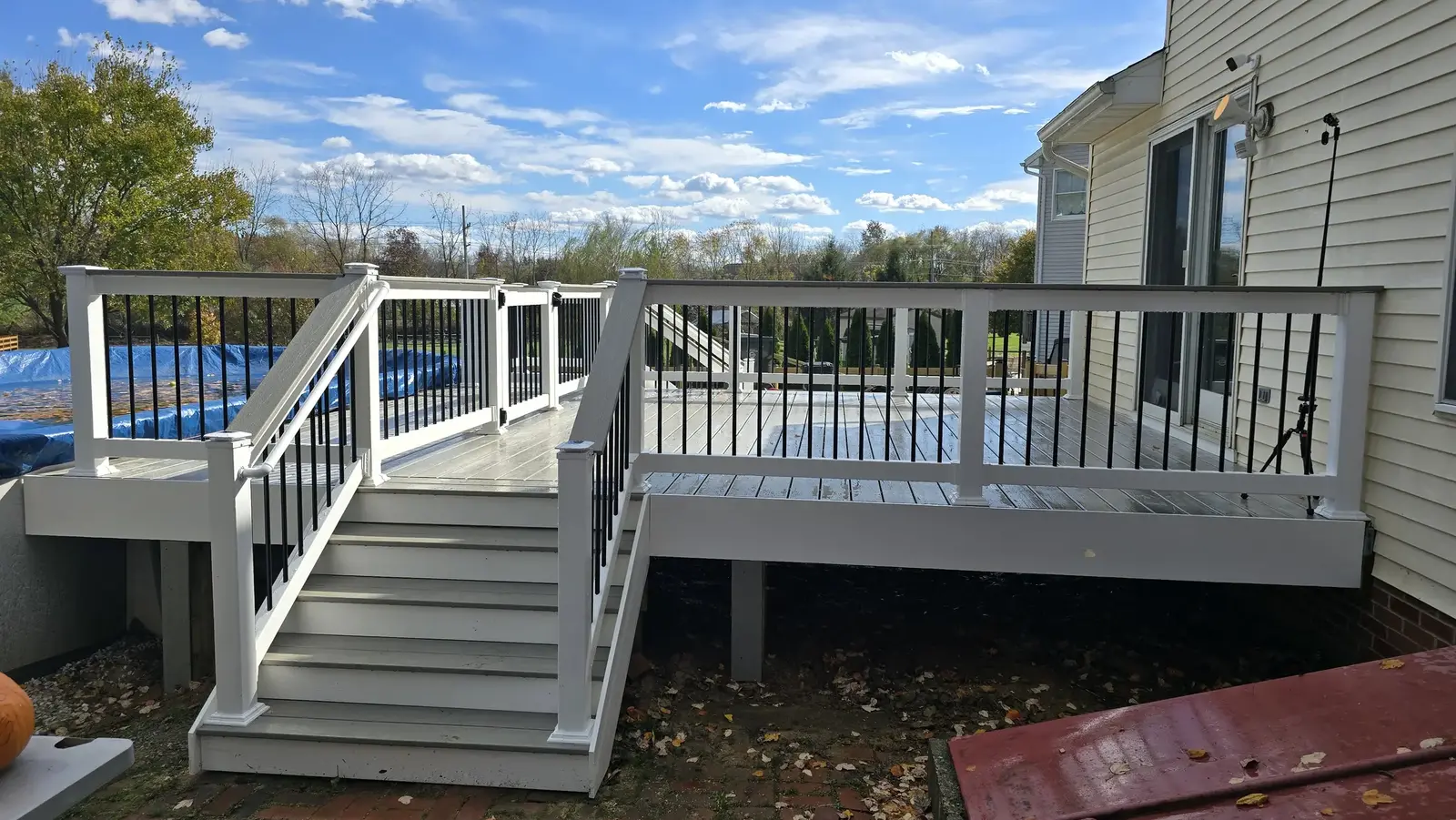
A deck can have clean boards, fresh stain, and a railing that looks straight while still having structural problems underneath.
That is because the walking surface is only one part of the deck.
The footings support the posts. The posts support the beams. The beams support the joists. On an attached deck, the ledger connects the structure to the house. Hardware, fasteners, flashing, railings, and stairs all have their own jobs.
If one part of that path is missing, deteriorated, or improperly connected, replacing a few deck boards will not correct the real problem.
When I evaluate a deck repair, I work from the ground up and look at how the entire structure carries weight.
A finished surface can hide the important details
Most homeowners naturally look at the part of the deck they use:
- Deck boards
- Railings
- Stairs
- Skirting
- Trim
- Stain or paint
Those parts matter, but many of the most important structural details are underneath or behind the finished surfaces.
A deck may have attractive boards covering joists that are soft, split, badly notched, or inadequately supported. A beam may look substantial while depending mainly on bolts through the side of a post. A ledger may be hidden behind siding even though water has been reaching the connection.
That is why I do not judge a deck only by its appearance from above.
I start with the deck’s load path
A load path is simply the route that the weight of the deck, furniture, snow, and people follows down to the ground or back to the house.
For a typical deck, I look at:
- Footings and soil
- Post bases
- Support posts
- Beams
- Joists and blocking
- Ledger and house connection
- Decking
- Railings
- Stairs and landings
Each part should be supported by the part below it and properly connected to the parts around it.
If a repair improves one component but leaves a weak connection directly beside it, the deck may still have the same basic problem.
Footings need solid support
A footing is supposed to transfer the deck’s weight into suitable soil.
I look for footings that have:
- Settled or shifted
- Become exposed by erosion
- Cracked or deteriorated
- Been placed on disturbed or poorly compacted soil
- Allowed a post to lean
- Become surrounded by standing water
- Been undermined by drainage
- Failed to provide adequate bearing for the post
The American Wood Council’s residential deck guide illustrates the basic principle that footings should bear on undisturbed soil and be sized for the loads and soil conditions involved. The guide is a useful technical reference, although the locally adopted code and approved project plans control an actual Maryland project. [Source]
Adding framing above a settling footing does not stop the settlement. The cause at ground level has to be considered.
If new excavation is required for a Darling Builders project, I handle the Miss Utility request. Homeowners still need to identify private underground systems that utility companies may not mark, such as irrigation, landscape lighting, invisible pet fencing, drainage lines, or private electrical work.
A post should support the beam—not merely sit beside it
One detail I examine closely is the beam-to-post connection.
A dependable load path normally provides direct bearing so the beam’s weight is carried by the post. The American Wood Council explains that deck beams carrying floor loads require full bearing at their supporting posts. [Source]
If a beam is fastened only to the side of a post, the connection may depend heavily on the bolts or screws instead of allowing the post itself to carry the load.
The correct repair depends on the framing, spans, available access, condition of the lumber, and approved design. Possible work could involve replacing posts, creating proper bearing, rebuilding a beam, or installing an appropriate engineered connection.
I do not assume that adding a few more screws automatically creates structural support.
Joist hangers need the correct fasteners
Joist hangers are easy to recognize, but the hanger itself is only one part of the connection.
I check:
- Whether a hanger is present
- Whether it fits the joist
- Whether the joist sits fully in it
- Whether all required holes are properly fastened
- Whether the fasteners are approved for that connector
- Whether the hanger or fasteners are corroded
- Whether the supporting wood is sound
- Whether the joist has adequate bearing at the beam
- Whether the joist is restrained from movement
Connector manufacturers publish specific fastening requirements. Ordinary drywall screws, roofing nails, or miscellaneous leftover fasteners should not be assumed suitable for structural hardware.
Current deck-connection guidance also addresses ledger, joist-to-beam, beam-to-post, railing, and other critical connections. [Source]
Replacing an incorrect fastener may be straightforward when the surrounding lumber remains sound. A hanger attached to deteriorated wood requires more than new nails.
Joists need more than a short patch over the damaged area
A joist may be damaged by:
- Rot
- Insects
- A long split
- An excessive notch or drilled opening
- Water trapped beneath the decking
- Poor bearing
- A failed hanger
- Previous alterations
- Repeated movement
Sometimes a joist can be reinforced. Other times it should be replaced.
The repair has to transfer the load across the affected area and reach appropriate bearing or connection points. A short board screwed over a soft section is not automatically a structural repair.
Before recommending reinforcement, I want to understand why the joist was damaged and whether nearby joists have the same condition.
The ledger deserves special attention
On many attached decks, the ledger is the board connecting the deck framing to the house.
Problems at this location can be serious because the connection may be carrying a substantial portion of the deck while remaining partly concealed by siding, trim, or decking.
I look for:
- Gaps between the ledger and house
- Missing, loose, or corroded fasteners
- Soft or deteriorated lumber
- Water staining
- Damaged or missing flashing
- Improper siding details
- Joist hangers pulling away
- Moisture damage in the house framing
- Previous repairs that conceal the connection
Flashing is intended to direct water away from the ledger and house. Proper ledger flashing is important because trapped moisture can lead to deterioration in areas that are difficult to see. [Source]
A repair might involve opening a limited area so the ledger, fasteners, flashing, and house framing can be evaluated. Until that area is accessible, nobody should promise that the full extent of concealed damage is already known.
Railings need structural connections too
A loose railing is not always caused by the visible screws at the base of the post.
The post may lack blocking, proper hardware, or a dependable connection to the deck framing. The framing supporting the post may also be deteriorated.
I check:
- Post condition
- Post spacing
- Blocking
- Connection hardware
- Fastener condition
- Movement in the rim or outside joist
- Stair-railing connections
- Whether the decking is being asked to support the post
A railing post should not depend mainly on a deck board to resist movement.
Driving another screw through the post may reduce movement temporarily, but it does not help if the screw is entering weak material or the framing behind the post is inadequate.
Stairs are a separate structural system
Deck stairs deserve their own evaluation.
I inspect:
- Stringer condition
- Stringer spacing
- Attachment at the deck
- Treads and risers
- Handrails and guardrails
- The bottom landing
- Settlement or erosion
- Rot near the ground
- Side-to-side movement
- Changes in rise or tread height
If the landing settles, the stairs can pull on their upper connection. If the top attachment moves, the entire stair run may become unstable.
Replacing one cracked tread will not correct deteriorated stringers or a failing landing.
Water usually explains part of the problem
When I find deterioration, I also look for the source of the moisture.
Common contributors include:
- Missing or damaged flashing
- A leaking gutter
- A downspout discharging near the deck
- Trapped leaves and debris
- Soil or mulch against wood
- Poor drainage around footings
- A shaded area that stays wet
- Water collecting against the house
- Improperly sealed penetrations
- Debris trapped between closely spaced boards
Replacing rotten lumber without correcting the water source can allow the same problem to return.
The best repair addresses both the damaged material and the reason it deteriorated.
Structural repair work may require a permit
Replacing an isolated deck board is different from rebuilding framing, supports, railings, or another structural component.
Frederick County states that a permit is required when a deck or porch is replaced, including replacement in the same location. Its published process also identifies replacement railings and structural repairs to an existing deck as permit work. [Source]
Washington County maintains its permit applications, inspection information, codes, zoning resources, and guidance through its Permits and Inspections division. [Source]
Requirements can depend on the location and scope. Incorporated municipalities may administer their own processes.
When a permit is required for Darling Builders work, I explain the requirement and handle pulling it unless our agreement specifically states otherwise.
The repair scope can change after concealed areas are opened
Structural deck work sometimes involves conditions that cannot be confirmed during the first visible inspection.
Examples include:
- Rot behind a ledger
- Damage behind siding
- Undersized or missing fasteners
- Deteriorated house framing
- Buried or concealed footings
- Multiple previous repairs
- Water damage beneath trim
- Hardware hidden by decking
I believe the homeowner should understand that possibility before work begins.
If concealed damage is discovered, the practical process is to stop at that area, document the condition, explain the correction, and provide the additional scope before proceeding with work outside the original agreement.
An honest estimate should distinguish between what can be confirmed now and what remains concealed.
When can a deck be repaired?
Repair may be practical when:
- The problem is limited to identifiable areas
- Most of the structure remains sound
- Proper bearing and connections can be restored
- Damaged framing can be replaced or reinforced correctly
- Moisture or drainage problems can be corrected
- The repaired deck will still meet the homeowner’s needs
- The work makes financial sense compared with replacement
Possible repairs might include:
- Correcting footings or supports
- Replacing posts
- Rebuilding a beam
- Replacing damaged joists
- Installing proper hangers or connectors
- Correcting ledger fastening and flashing
- Rebuilding stairs
- Reinforcing railing-post connections
- Replacing isolated decking
The presence of one structural issue does not automatically mean the entire deck needs replacement.
When might replacement make more sense?
Replacement may be the better choice when:
- Deterioration affects several parts of the structure
- The ledger or house framing has extensive damage
- Footings, posts, beams, and joists all require major correction
- Previous modifications have created several structural conflicts
- The layout no longer works for the homeowner
- The deck is too small or the stairs are poorly located
- Repair would leave substantial older framing with a limited useful life
- The cost and disruption of extensive repairs approach a complete rebuild
I do not believe in replacing more than necessary. I also do not want to sell a homeowner a series of patches when the structure really needs a coordinated rebuild.
What to send when requesting a deck-repair estimate
The following information helps me prepare for the visit:
- A wide photograph of the entire deck
- Photographs from underneath
- Close-ups of the posts, beams, and footings
- Pictures of the ledger area
- Photographs of loose railings or damaged stairs
- A short video showing movement
- Approximate deck dimensions
- The deck’s approximate age, if known
- Details about previous repairs
- Whether the condition changes after rain
- Any permit or plan information the homeowner already has
Photographs are helpful, but they cannot reveal every concealed condition. An on-site evaluation is normally needed before I can recommend a structural repair.
My bottom line
A deck does not become structurally sound because the top looks finished.
I want to know how the weight reaches the ground, how the deck connects to the house, whether water is being controlled, and whether each repair restores a dependable connection.
Sometimes the answer is a limited repair. Sometimes several components need to be corrected together. Occasionally replacement is the more practical option.
The important part is repairing the structure carrying the load—not simply covering the symptom.
Darling Builders provides deck-repair and replacement estimates throughout Washington County and Frederick County, Maryland.
Concerned about your deck framing, ledger, footings, stairs, or railings? Request a free on-site estimate, and I’ll explain what I can see, what may remain concealed, and which repair options make practical sense.
Common questions
Frequently asked questions
Can a deck look safe but still have structural problems?
Yes. Decking and trim can conceal damaged joists, improper fasteners, missing flashing, weak ledger connections, inadequate beam support, or deteriorated framing.
Does one damaged joist mean the deck needs replacement?
Not necessarily. An isolated joist may be repairable or replaceable if the surrounding structure is sound. The damage, bearing points, span, connections, and cause should be evaluated first.
Can you repair a deck beam that is bolted to the side of a post?
Possibly. The correction depends on the beam, post, framing layout, spans, condition, and available bearing. The repair may require rebuilding the connection, replacing a post, or installing an approved structural solution.
Can incorrect joist-hanger screws simply be replaced?
Sometimes. The hanger, joist, supporting lumber, holes, corrosion, and original installation must also be inspected. New fasteners will not correct deteriorated wood or an incorrectly sized hanger.
Why is deck-ledger flashing important?
Flashing directs water away from the connection between the deck and house. Missing or damaged flashing can allow concealed deterioration in the ledger and nearby house framing.
Do structural deck repairs require a Maryland building permit?
They may. Requirements depend on the work and jurisdiction. Frederick County specifically identifies structural deck repairs and railing replacement as permit work. Darling Builders explains applicable requirements and handles permits for our contracted work unless stated otherwise.
Can Darling Builders replace decking while keeping the existing frame?
Possibly. I first inspect the framing, spacing, spans, bearing, ledger, supports, hardware, and overall condition. New decking should not be installed over framing that is deteriorated or unsuitable for the selected product.
Should I keep using a deck with visible movement?
If the deck, stairs, railing, posts, or house connection move noticeably or appear unstable, limit access and have the structure evaluated. Do not test it by deliberately shaking it or adding weight.
Plan your project
Let’s look at your property.
Darling Builders provides free on-site estimates throughout Washington and Frederick Counties, Maryland. We’ll discuss your goals, site conditions, materials, and the work your project requires.